Tag: procalcitonin

  • How COVID-19 Impacts Certain Biomarkers in Patients

    How COVID-19 Impacts Certain Biomarkers in Patients

    As a medical device manufacturer, we have been closely monitoring the research that is currently being conducted into the detection of SARS-CoV-2.  Response Biomedical’s purpose is to improve and save as many lives as possible, and we strive to provide our channel partners with the most recent and relevant information.

    Various literature has been found which broadly defines the clinical characteristics of COVID-19. However, the laboratory abnormalities for these patients depends significantly on the patient’s clinical presentation at the time of evaluation. Most of these tests have been found useful for hospitalized patients and show a trend which indicates whether a patient is either improving or progressing to a more critical state.

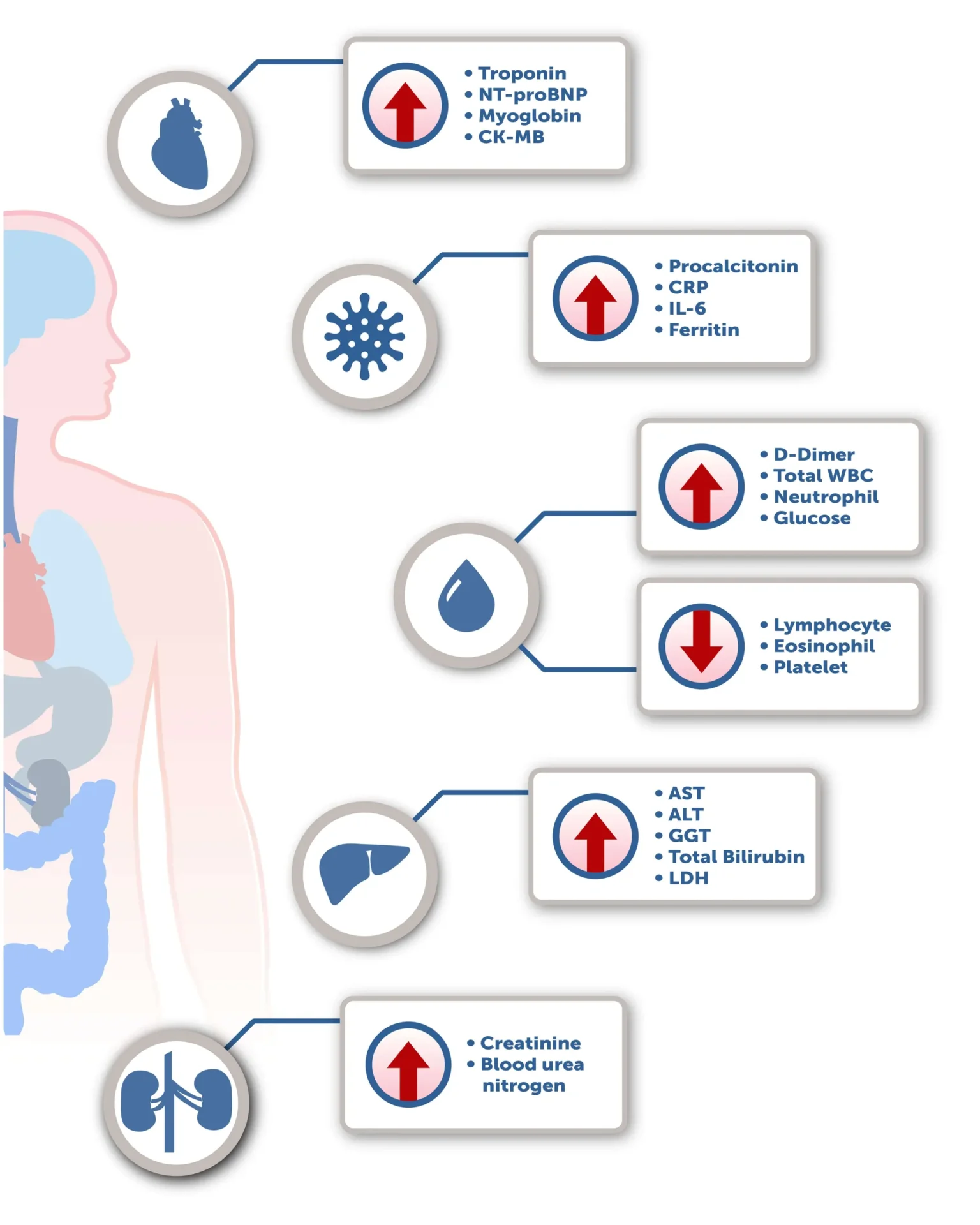
    As may occur in other infections, leukopenia and leukocytosis are common in COVID-19. Patients with more severe infection have had elevations of liver enzymes, muscle enzymes, C-reactive protein, lactate dehydrogenase, and ferritin. [1, 2] Several papers have also shown increased procalcitonin(PCT) and D-dimer levels in patients with a severe infection. [3,4] While not typically elevated in patients with viral infection, progressive increases in PCT values have been shown to correlate with worse prognosis, likely related to bacterial superinfection. Elevated D-dimer levels have been strongly associated with greater risk of death and thrombotic complications, most frequently deep venous thrombosis, and pulmonary embolism. [5-7] Elevated troponin levels are common in severe COVID-19 cases; while patients with comorbidities such as hypertension, CAD, COPD or diabetes are at higher risk, substantial heart damage has occurred in patients without any underlying cardiovascular disease. [8-10]

    Please note, all studies mentioned in this COVID-19 update were not completed using RAMP products manufactured by Response Biomedical Corp. RAMP products have not been evaluated specifically for use with COVID-19 patients.

    References:

    1 Huang C; Wang Y; Li X; Ren L; Zhao J; Hu Y; Zhang L; Fan G; Xu J; Gu X; Cheng Z; Yu T; Xia J; Wei Y; Wu W; Xie X; Yin W; Li H; Liu M; Xiao Y; Gao H; Guo L; Xie J; Wang G; Jiang R; Gao Z; Jin Q; Wang J; Cao B. Clinical features of patients infected with 2019 novel coronavirus in Wuhan, China. Lancet.  2020; 395(10223):497-506

    https://www.thelancet.com/pdfs/journals/lancet/PIIS0140-6736(20)30183-5.pdf

    2 Wu Z; McGoogan JM. Characteristics of and Important Lessons from the Coronavirus Disease 2019 (COVID-19) Outbreak in China: Summary of a Report of 72 314 Cases from the Chinese Center for Disease Control and Prevention. JAMA. 2020;323(13):1239–1242

    https://jamanetwork.com/journals/jama/fullarticle/2762130

    3 Lippi G; Plebani M. Laboratory abnormalities in patients with COVID-2019 infection. Clinical Chemistry and Laboratory Medicine (CCLM)58(7), 1131-1134

    https://www.degruyter.com/view/journals/cclm/58/7/article-p1131.xml

    4 Zhang, J‐J, Dong, X, Cao, Y‐Y, et al. Clinical characteristics of 140 patients infected with SARS‐CoV‐2 in Wuhan, ChinaAllergy. 2020; 75: 1730– 1741.

    https://onlinelibrary.wiley.com/doi/full/10.1111/all.14238

    5 Bikdeli B, Madhavan M, Jimenez D, et al. COVID-19 and Thrombotic or Thromboembolic Disease: Implications for Prevention, Antithrombotic Therapy, and Follow-up. J Am Coll Cardiol. 2020 Jun, 75 (23) 2950-2973.

    https://www.onlinejacc.org/content/75/23/2950.full

    6 Cannegieter, SC, Klok, FA. COVID‐19 associated coagulopathy and thromboembolic disease: Commentary on an interim expert guidance. Res Pract Thromb Haemost. 2020; 4: 439– 445.

    https://onlinelibrary.wiley.com/doi/abs/10.1002/rth2.12350

    7 Lippi G, Favaloro EJ. D-dimer is associated with severity of coronavirus disease 2019 (COVID-19): a pooled analysis.  Thromb Haemost 2020; 120(05): 876-878.

    https://www.thieme-connect.com/products/ejournals/abstract/10.1055/s-0040-1709650#

    8 Guo T, Fan Y, Chen M, et al. Cardiovascular Implications of Fatal Outcomes of Patients With Coronavirus Disease 2019 (COVID-19). JAMA Cardiol. 2020;5(7):1-8.

    https://jamanetwork.com/journals/jamacardiology/fullarticle/2763845

    9 Canadian Cardiovascular Society (2020). Guidance from the CCS COVID-19 Rapid Response Team. COVID-19 and Cardiovascular Disease: What the Cardiac Healthcare Provider Should Know. https://www.ccs.ca/images/Images_2020/COVID_and_Cardiovascular_Disease_22Mar2020.pdf

    10 Zheng YY, Ma YT, Zhang JY, Xie X. COVID-19 and the cardiovascular system. Nat Rev Cardiol. 2020. 17:259–260.

  • New COVID-19 Guidelines in Relation to Acute Coronary Syndrome and Sepsis

    New COVID-19 Guidelines in Relation to Acute Coronary Syndrome and Sepsis

    As the amount of available information and research into COVID-19 is constantly changing, we wish to continue to provide you with updated information.  Please find recent guidelines regarding COVID-19 and how it relates to acute coronary syndrome (ACS) and sepsis below.

    The Canadian Cardiovascular Society COVID-19 Rapid Response Team has recently released “COVID-19 and Cardiovascular Disease: What the Cardiac Healthcare Provider Should Know.1 Several interesting points that may be of interest include:

    • Myocardial injury defined as an elevation in troponin level is common (7-17%)
    • Troponin elevations are more common in severe illness vs non-severe and are associated with worse outcomes
    • Severe disease includes a subgroup of patients who reportedly develop a cytokine storm syndrome, including elevated NT-proBNP (27.5%), troponin (10%) and interleukin-6 levels
    • Recent data from Seattle suggests cardiomyopathy was common (7%), however patients had a high rate of prior congestive heart failure (42%)

    Additionally, a recent critical care guideline for the management of critically ill adults with COVID-192 has stated the following:

    • The prognosis of patients with COVID-19 and shock has not been systematically reported. In a study of 150 patients from 2 hospitals in Wuhan, China, shock was a major reason for death in 40%, and may, at least in part, be due to fulminant myocarditis.
    • Studies on risk factors associated with shock in patients with COVID-19 are lacking. The majority of those that are available report unadjusted estimates. Despite methodological limitations, these studies suggest that older age, comorbidities (especially diabetes and cardiovascular disease including hypertension), lower lymphocyte count, higher D-dimer level, and possibly cardiac injury are risk factors to consider.

    Please note, all studies mentioned in this COVID-19 update were not completed using RAMP products manufactured by Response Biomedical Corp.  RAMP products have not been evaluated specifically for use with COVID-19 patients.

    Please find the mentioned guidelines links below.

    1 Canadian Cardiovascular Society (2020). Guidance from the CCS COVID-19 Rapid Response Team. COVID-19 and Cardiovascular Disease: What the Cardiac Healthcare Provider Should Know. https://www.ccs.ca/images/Images_2020/COVID_and_Cardiovascular_Disease_22Mar2020.pdf

    2 Alhazzani, W., Møller, M. H., Arabi, Y. M., Loeb, M., Gong, M. N., Fan, E., … & Du, B. (2020). Surviving Sepsis Campaign: guidelines on the management of critically ill adults with Coronavirus Disease 2019 (COVID-19). Intensive Care Medicine, 1-34 https://www.sccm.org/getattachment/Disaster/SSC-COVID19-Critical-Care-Guidelines.pdf?lang=en-US

  • Procalcitonin and D-dimer in Patients with COVID-19

    Procalcitonin and D-dimer in Patients with COVID-19

    As a medical device manufacturer, we have been closely monitoring the research that is currently being conducted into the detection of COVID-19.  Response Biomedical’s purpose is to save as many human lives as possible, and we strive to provide our channel partners with the most recent and relevant information.

    The following systematic literature review by Lippi and Plebani highlights the important abnormalities observed in patients with COVID-19.1 The review cites several papers which show increased Procalcitonin (PCT) and D-dimer levels in patients with a severe COVID-19 infection compared to those with milder symptoms.  In fact, a study conducted by Zhang et al. found that 25% of patients with COVID-19 who were admitted to the ICU had elevated PCT levels compared to 0% who were not admitted to the ICU.2  Furthermore, PCT can potentially be used prognostically as the progressive increase of its values seem to reflect a poorer outcome in patients with COVID-19.

    A meta-analysis of literature also performed by Lippi and Plebani shows an increase in PCT values associated with a nearly 5-fold higher risk of severe COVID-19 infection.3

    Please note, all studies mentioned in this COVID-19 update were not completed using RAMP products manufactured by Response Biomedical Corp.  RAMP products have not been evaluated specifically for use with COVID-19 patients.

    Please find the links to the mentioned articles below.

    1 Lippi, G., & Plebani, M. (2020). Laboratory abnormalities in patients with COVID-2019 infection. Clinical Chemistry and Laboratory Medicine (CCLM), (0), 20200198. https://www.degruyter.com/downloadpdf/j/cclm.ahead-of-print/cclm-2020-0198/cclm-2020-0198.pdf

    2 Zhang, J. J., Dong, X., Cao, Y. Y., Yuan, Y. D., Yang, Y. B., Yan, Y. Q., … & Gao, Y. D. (2020). Clinical characteristics of 140 patients infected by SARS‐CoV‐2 in Wuhan, China. Allergy. https://onlinelibrary.wiley.com/doi/pdf/10.1111/all.14238

    3 Lippi, G., & Plebani, M. (2020). Procalcitonin in patients with severe coronavirus disease 2019 (COVID-19): a meta-analysis. Clinica Chimica Acta; International Journal of Clinical Chemistry. https://www.sciencedirect.com/science/article/pii/S0009898120301066?via%3Dihu